Welcome To Our Company!


 Send Inquiry
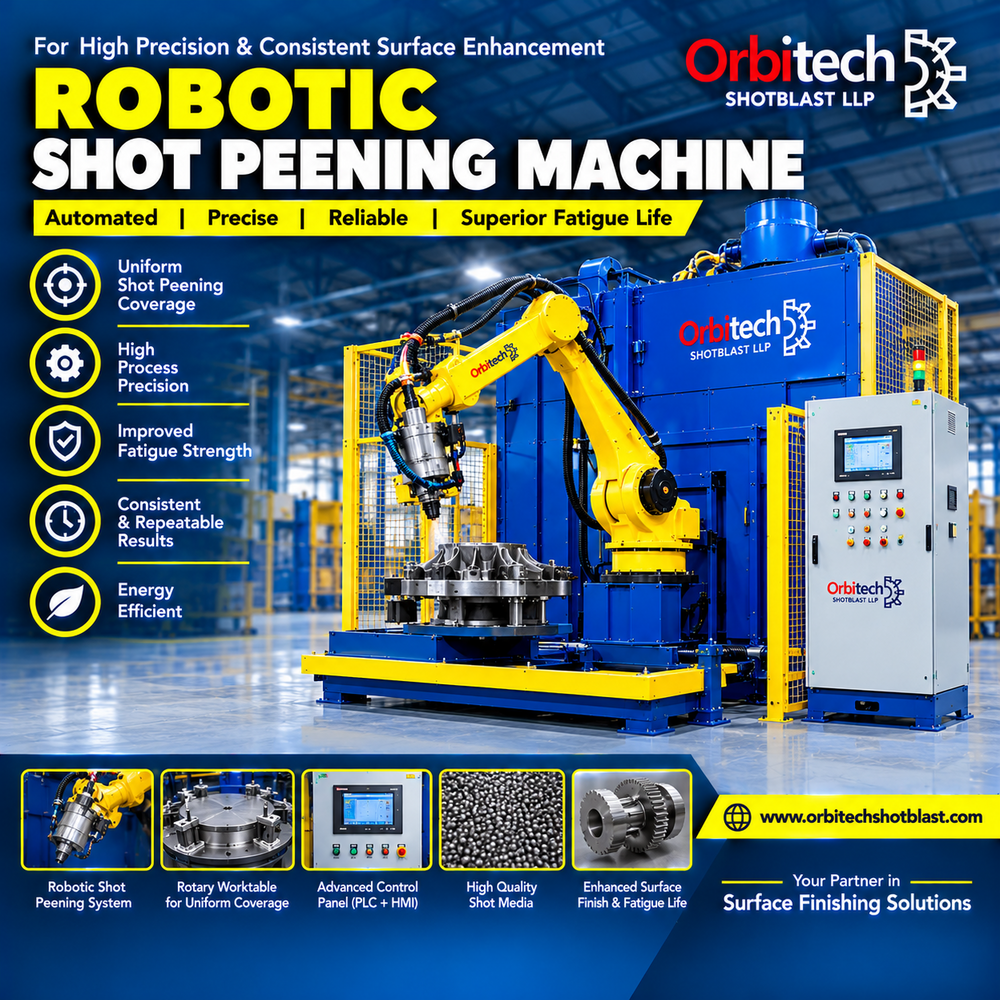
Robotic Shot Peening Machine
Price 300000.00 INR/ Piece
MOQ : 1 Piece
Robotic Shot Peening Machine Specification
- Motor Type
- Servo Motor Driven
- Capacity
- Customizable as per Requirement
- Dimension (L*W*H)
- 5000 x 3500 x 3000 mm
- Weight
- Approx. 3200 kg
- Application
- Surface Finishing, Stress Relieving, Fatigue Life Enhancement
- Power
- 15 kW
- Voltage
- 380 V, 3 Phase, 50/60 Hz
- Design
- Robust Industrial Robotic Arm
- Safety Features
- Interlocked Door, Emergency Stop, Safety Light Curtains
- Robot Axis
- 6 Axis Articulated Robot
- Automation Grade
- Fully Automatic
- Peening Coverage
- Full 3D Component Access
- Cleaning System
- On-line Media Separation and Recycling Unit
- Finish Level
- Controlled Almen Intensity
- Blast Pressure
- Adjustable, Up to 8 bar
- Shot Media Compatibility
- Steel Shot, Glass Beads, Ceramic Beads
- Control System
- PLC Based with HMI Interface
- Dust Collection
- Integrated Cartridge Dust Collector
- Cycle Time
- Programmable as per Component Geometry
- Nozzle Type
- High Precision Programmable Nozzle
Robotic Shot Peening Machine Trade Information
- Minimum Order Quantity
- 1 Piece
- Supply Ability
- 10 Pieces Per Month
- Delivery Time
- 1 Months
- Packaging Details
- Standard Packaging
- Main Export Market(s)
- Western Europe, Australia, North America, Eastern Europe, Middle East, Central America, South America, Asia, Africa
- Main Domestic Market
- All India
About Robotic Shot Peening Machine
Robotic Shot Peening Machine Manufacturer in India Orbitech Shotblast LLP
Product Description
Orbitech Shotblast LLP is a manufacturer and supplier of Robotic Shot Peening Machines in India, offering automated surface treatment solutions for precision-engineered metal components. Designed for applications where controlled and repeatable shot peening is essential, this machine combines robotic movement, programmable abrasive delivery, and automated process controls to treat complex component geometries.
Unlike conventional manual shot peening systems, a Robotic Shot Peening Machine uses a programmable robotic arm to direct the peening nozzle along predefined paths. The controlled impact of spherical shot media creates small, localized indentations on the metal surface, inducing beneficial compressive residual stresses in the treated layer. When properly developed and validated, this process can improve fatigue resistance and help extend the service life of components subjected to cyclic loading.
The machine is suitable for applications that require accurate nozzle positioning, repeatable coverage, and controlled peening intensity. Its robotic movement allows access to curved surfaces, edges, recesses, and complex three-dimensional components that may be difficult to process consistently using manual methods.
A typical system integrates a robotic arm, enclosed blasting chamber, programmable control system, shot delivery unit, media separation and recycling arrangement, and industrial dust collector. Process parameters can be configured according to component geometry, material properties, specified peening intensity, and production requirements.
As a Robotic Shot Peening Machine manufacturer and supplier in India, Orbitech Shotblast LLP provides industrial automation solutions for manufacturers seeking precision-oriented surface treatment, repeatable processing, and improved production control.
Advantages of Robotic Shot Peening Machine
- Improved Fatigue Resistance: Properly controlled shot peening can improve resistance to fatigue cracking in suitable metal components.
- Controlled Residual Stress: The process introduces beneficial compressive residual stresses in the treated surface layer.
- Precise Robotic Movement: Programmable robotic paths support repeatable nozzle positioning across complex geometries.
- Three-Dimensional Coverage: A multi-axis robot can access multiple surfaces, curved profiles, and selected recessed areas.
- Repeatable Processing: Stored programs help maintain consistent movement and process parameters between production cycles.
- Reduced Manual Intervention: Automated nozzle movement reduces dependence on manual peening operations.Programmable Peening Intensity: Media flow, nozzle distance, traverse speed, and pressure or wheel settings can be developed for the required process.
- Complex Component Handling: Suitable robotic tooling and fixtures allow different component geometries to be accommodated.
- Media Recovery: The integrated separation system helps recover reusable shot media.
- Dust Management: Industrial dust extraction helps control airborne particles generated during operation.
- Production Traceability: Programmable controls can support recording of selected process parameters and cycle information.
- Flexible Automation: Robot paths and fixtures can be adapted for different approved component programs.
Key Features
- Industrial multi-axis robotic arm, typically with six axes.
- Programmable peening nozzle for controlled shot delivery.
- PLC-based control system with HMI interface.
- Servo-driven robotic positioning.
- Adjustable shot delivery parameters.
- Configurable nozzle angle, stand-off distance, and traverse speed.
- Shot media recovery, separation, and recycling system.
- Integrated cartridge-type dust collector.
- Component-specific fixtures and locating arrangements.
- Programmable operating cycles for different component geometries.
- Safety interlocked chamber doors and emergency-stop controls.
- Optional safety light curtains and robotic cell monitoring.
- Provision for process monitoring and parameter recording, depending on configuration.
- Application-specific robot reach, payload, and work envelope.
Applications and Usage
The Robotic Shot Peening Machine is suitable for industrial components that require controlled peening to improve fatigue performance or meet an engineered surface-treatment specification.
Common applications include:
- Aerospace and aviation components approved for shot peening.
- Turbine blades and selected turbine components.
- Automotive gears, shafts, springs, and transmission components.
- Railway components requiring specified fatigue performance.
- Precision-machined metal parts subjected to cyclic loading.
- Forged components and selected high-strength steel parts.
- Industrial machinery components exposed to repeated stress.
- Selected aerospace structural components.
- Components with curved surfaces or complex three-dimensional profiles.
- Production lines requiring automated, repeatable peening operations.
The exact application must be validated against the component material, geometry, stress condition, and engineering specification. Shot peening is a controlled surface engineering process, not simply a cleaning operation. Incorrect media, intensity, coverage, or processing time can damage a component or cause it to fail its required specification.
Working Principle
The Robotic Shot Peening Machine operates by directing a controlled stream of shot media onto a component surface using a programmable robotic arm.
First, the component is secured in a fixture inside the enclosed peening chamber. The robot follows a programmed path based on the component's geometry and the surfaces that require treatment. A pneumatic nozzle or other specified shot delivery system propels suitable shot media toward the target surface at the required operating conditions.
When the spherical shot impacts the metal, it creates small plastic indentations. The surrounding material constrains the deformed surface layer, producing beneficial compressive residual stresses. When the process is correctly designed, these stresses can help delay fatigue crack initiation and propagation under suitable service conditions.
The robot controls the nozzle's position, orientation, movement, and travel path to achieve the required coverage. Process settings such as shot flow, pressure or velocity, nozzle distance, and traverse speed are established during process development. Peening intensity and coverage are validated using appropriate methods, such as Almen strips and coverage inspection, where applicable.
After impact, the media and process debris are collected by the recovery system. Suitable reusable shot is separated from dust and unwanted particles before recirculation. The dust collector manages airborne contaminants, while the control system coordinates the robot and peening cycle.
Following processing, the component is inspected against the approved engineering specification. Critical applications may require documented verification of peening intensity, coverage, media condition, and other process controls.
Technical Specifications
The following specifications are based on an indicative Robotic Shot Peening Machine configuration. Actual performance and machine selection depend on robot reach, component geometry, media type, and the required peening process.
| Specification | Indicative Details |
| Product Name | Robotic Shot Peening Machine |
| Machine Type | Fully Automatic Robotic Shot Peening System |
| Overall Dimensions | 5000 3500 3000 mm |
| Approximate Machine Weight | 3200 kg |
| Robotic System | Industrial Servo-Driven Robotic Arm |
| Robot Configuration | 6-Axis Articulated Robot |
| Capacity | Customizable according to component and cycle requirements |
| Total Installed Power | Approximately 15 kW |
| Electrical Supply | 380 V, 3-Phase, 50/60 Hz |
| Control System | PLC-Based Control with HMI Interface |
| Shot Delivery | Programmable High-Precision Nozzle |
| Blast Pressure | Adjustable, up to approximately 8 bar for a suitable pneumatic configuration |
| Shot Media | Compatible steel shot, ceramic shot, or other specified peening media |
| Media Recovery | Online media separation and recycling system |
| Dust Collection | Integrated Cartridge-Type Dust Collector |
| Component Coverage | Programmable Multi-Axis Surface Access |
| Peening Intensity | Established according to the component specification and validated process |
| Cycle Time | Programmable according to component geometry and coverage requirement |
| Safety Features | Interlocked doors, emergency stops, and optional light curtains |
| Workpiece Handling | Application-specific fixtures and loading arrangements |
| Automation Grade | Fully Automatic, configuration dependent |
| Manufacturing Origin | India |
| System Configuration | Standard or application-specific |
Specification note: The figures above are reference values for website content and are not independently verified factory specifications. Robot reach, payload, shot delivery pressure, media type, power requirements, and process capacity must be confirmed against the final machine configuration. The listed maximum pressure applies only where the selected pneumatic delivery system supports it.
Why Choose Orbitech Shotblast LLP?
Orbitech Shotblast LLP provides industrial shot blasting and shot peening equipment for manufacturers seeking automated surface treatment solutions. Our Robotic Shot Peening Machine is designed around the requirements of components that need controlled peening paths and repeatable processing.
- Manufacturer and Supplier in India: Industrial surface treatment equipment for diverse manufacturing applications.
- Robotic Process Control: Programmable movement helps achieve repeatable nozzle paths.
- Application-Based Configuration: Robot reach, fixtures, media delivery, and chamber layout can be selected according to the workpiece.
- Complex Geometry Access: Multi-axis robotic movement supports treatment of suitable three-dimensional components.
- Automated Media Handling: Recovery and separation equipment helps maintain media circulation.
- Dust Extraction: Supports control of airborne particles during peening operations.
- Programmable Production Cycles: Stored recipes can support repeatable operation for approved component programs.
- Safety-Focused Design: Enclosed processing and appropriate interlocks help protect operators.
- Technical Assistance: Support with machine selection based on component geometry, required coverage, and production needs.
For businesses searching for a Robotic Shot Peening Machine manufacturer in India or a Robotic Shot Peening Machine supplier, Orbitech Shotblast LLP offers automation-oriented equipment for controlled industrial surface treatment.
Frequently Asked Questions (FAQs)
1. What is a Robotic Shot Peening Machine?
A Robotic Shot Peening Machine uses a programmable robotic arm to direct shot media onto specified component surfaces. The impact produces localized plastic deformation and can introduce beneficial compressive residual stresses.
2. What is the main purpose of robotic shot peening?
Its primary purpose is to improve fatigue performance in suitable components by introducing compressive residual stresses at the surface. It is commonly used where components experience repeated or cyclic loading.
3. How is robotic shot peening different from conventional shot blasting?
Conventional shot blasting is commonly used to remove rust, scale, and surface contaminants. Shot peening is a controlled surface engineering process intended to modify residual stress and improve fatigue performance. The required media, intensity, coverage, and verification methods differ.
4. Which components can be treated with a robotic shot peening system?
Depending on robot reach, fixtures, and process capability, it can treat selected gears, shafts, springs, turbine components, aerospace parts, and other metal components requiring engineered peening.
5. Which shot media can be used in the machine?
Suitable media may include steel shot, ceramic shot, or other specified peening media. Media selection depends on the component material, required intensity, surface condition, and applicable engineering standard.
6. Can the robotic arm process complex component geometries?
Yes. A multi-axis robotic arm can follow programmed paths around curved and three-dimensional surfaces. The achievable coverage depends on robot reach, fixture design, nozzle orientation, and access to the target areas.
7. How is shot peening intensity controlled?
Intensity is controlled through validated process parameters such as media type and size, shot velocity or pressure, media flow rate, nozzle distance, and traverse speed. Almen strips or other approved verification methods may be used to establish and monitor intensity.
8. Does robotic shot peening improve fatigue life?
Properly developed shot peening can improve fatigue resistance in suitable components by introducing compressive residual stresses. The actual benefit depends on material properties, component design, process control, and operating conditions; it is not guaranteed for every component.
9. Does the machine include a media recovery and dust collection system?
A typical configuration includes media separation and recycling equipment along with a dust collector. These systems help maintain media quality and manage airborne particles during operation.
10. How do I choose the right Robotic Shot Peening Machine manufacturer and supplier in India?
Evaluate robot reach and payload, shot delivery method, media compatibility, fixture design, process monitoring, safety systems, and the ability to validate required intensity and coverage. Orbitech Shotblast LLP can help identify a suitable configuration based on the component geometry, production requirements, and applicable engineering specification.
Tell us about your requirement

Price:
Quantity
Select Unit
- 50
- 100
- 200
- 250
- 500
- 1000+
Additional detail
Mobile number
Email

More Products in Shot Peening Machine Category
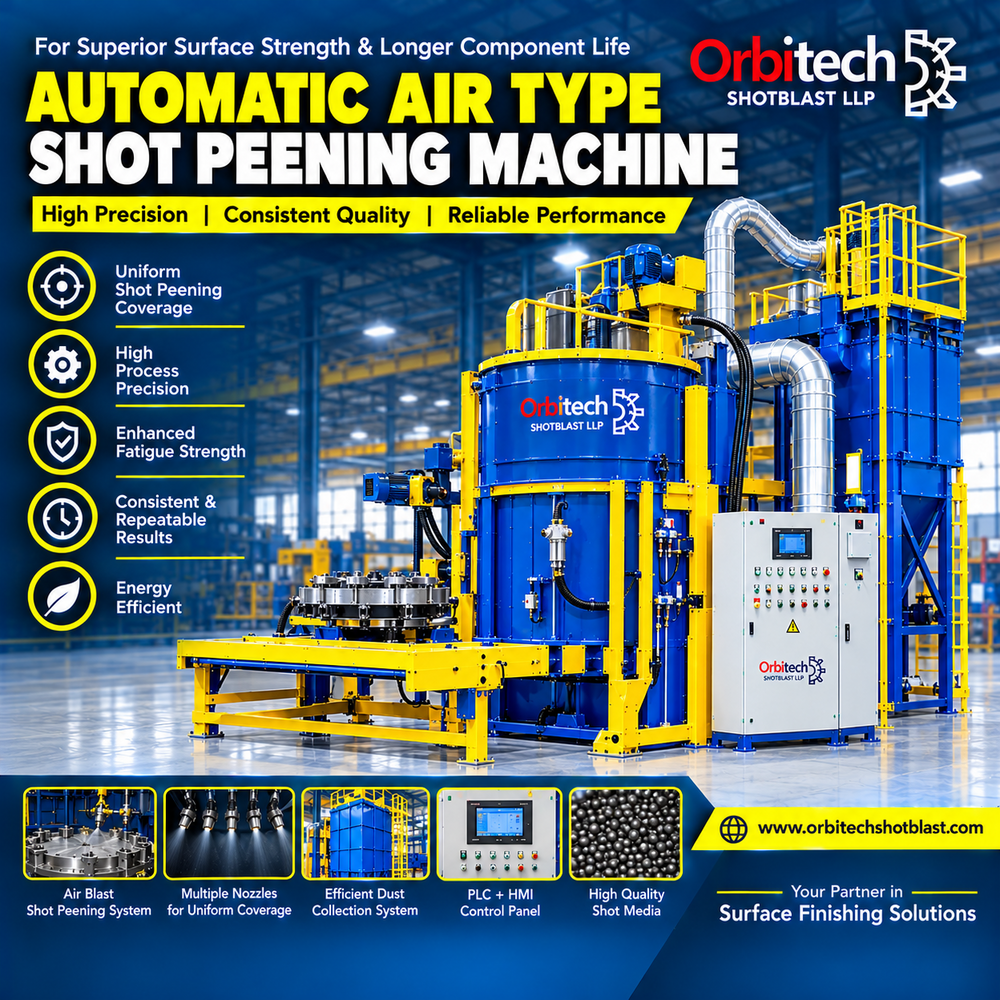
Automatic Air type Shot Peening Machine
Price 300000.00 INR / Piece
Minimum Order Quantity : 1 Piece
Weight : Approx. 3800 kg
Power : 7.5 kW to 22 kW (based on model)
Dimension (L*W*H) : 3200 mm x 2200 mm x 3500 mm
Motor Type : Three Phase Electric Motor


Delivering high-quality shot blasting machines that ser the standard for performance, reliability, and long-term value.


Contact Details

- No. C-9, Shankar Patel Estate, Manjusar- Savli Road,Vadodara - 391775, Gujarat, India
- Phone : 07971459110
ORBITECH SHOTBLAST LLP
GST : 24AAJFO6520G1ZE

- Mr Charchil Chokshi (Proprietor)
- Mobile : 07971459110
- Send Inquiry
- Direct No : +919313637084
 Send Inquiry
 Send Inquiry
 Send SMS
 Call Me Free

ORBITECH SHOTBLASTING EQUIPMENTS
All Rights Reserved.(Terms of Use)
Developed and Managed by Infocom Network Private Limited.
Developed and Managed by Infocom Network Private Limited.


 English
 Spanish
 French
 German
 Italian
 Chinese (Simplified)
 Japanese
 Korean
 Arabic
 Portuguese
